
1372. Longest ZigZag Path in a Binary Tree
1372. Longest ZigZag Path in a Binary Tree
문제
You are given the root of a binary tree.
A ZigZag path for a binary tree is defined as follow:
-
Choose any node in the binary tree and a direction (right or left).
-
If the current direction is right, move to the right child of the
-
current node; otherwise, move to the left child.
-
Change the direction from right to left or from left to right.
-
Repeat the second and third steps until you can’t move in the tree.
Zigzag length is defined as the number of nodes visited - 1. (A single node has a length of 0). Return the longest ZigZag path contained in that tree.
Example 1:
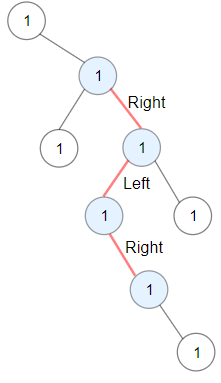 Input: root = [1,null,1,1,1,null,null,1,1,null,1,null,null,null,1]
Output: 3
Explanation: Longest ZigZag path in blue nodes (right -> left -> right).
Input: root = [1,null,1,1,1,null,null,1,1,null,1,null,null,null,1]
Output: 3
Explanation: Longest ZigZag path in blue nodes (right -> left -> right).
Example 2:
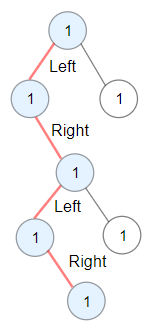 Input: root = [1,1,1,null,1,null,null,1,1,null,1]
Output: 4
Explanation: Longest ZigZag path in blue nodes (left -> right -> left -> right).
Input: root = [1,1,1,null,1,null,null,1,1,null,1]
Output: 4
Explanation: Longest ZigZag path in blue nodes (left -> right -> left -> right).
Example 3: Input: root = [1] Output: 0
Constraints:
The number of nodes in the tree is in the range [1, 5 * 10^4]. 1 <= Node.val <= 100
문제 해석
- 이진 트리에서 지그재그로 이동할 수 있는 최대 횟수를 물어보는 문제
구현
class Solution {
public:
    int longestZigZag(TreeNode* root) {
        ZigZag(root, true, 0);

        return count;
    }

    int count = 0;
    void ZigZag(TreeNode* node, bool goleft, int step) {
        if(!node)   return;
        count = max(count, step);
        if(goleft) // 이전에 오른쪽으로 갔었다는 것이므로 왼쪽으로 가야함
        {
            ZigZag(node->left, false, step + 1);
            ZigZag(node->right, true, 1);
        }
        else
        {
            ZigZag(node->left, false, 1);
            ZigZag(node->right, true, step+1);
        }
    }
};