
118. Pascal's Triangle
118. Pascal’s Triangle
문제
Given an integer numRows, return the first numRows of Pascal’s triangle.
In Pascal’s triangle, each number is the sum of the two numbers directly above it as shown:
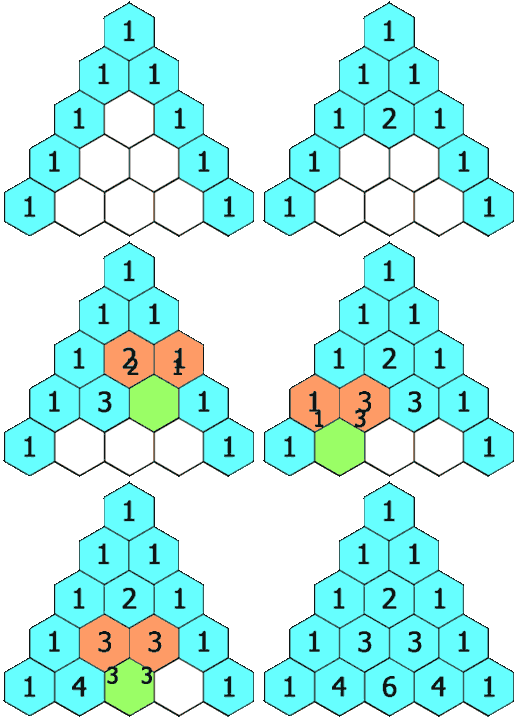
Example 1: Input: numRows = 5 Output: [[[[1],[1,1],[1,2,1],[1,3,3,1],[1,4,6,4,1]]]]
Example 2: Input: numRows = 1 Output: [[[1]]]
Constraints:
- 1 <= numRows <= 30
문제 해석
- 파스칼 삼각형을 구현해보는 문제이다.
코드 구현(재귀적 방법)
class Solution {
public:
    vector<vector<int>> generate(int numRows) {
        if(numRows == 0)    return {};
        if(numRows == 1)    return 1;

        vector<vector<int>> newprev = generate(numRows - 1);
        vector<int> newRows(numRows, 1);

        for(int i = 1; i < numRows - 1; ++i)
        {
            newRows = newprev.back()[i - 1] + newprev.back()[i];
        }

        newprev.push_back(newRows);
        return newprev;
    }
};
코드 해석
if(numRows == 0)    return {};
if(numRows == 1)    return 1;
- 파스칼 삼각형 특징으로 첫번째 배열 고정
vector<vector<int>> newprev = generate(numRows - 1);
vector<int> newRows(numRows, 1);
- 재귀적인 방법으로 정답을 담을 newprev 객체 생성과 파스칼 삼각형 계산을 위한 newRows 배열 생성(1로 초기화)
for(int i = 1; i < numRows - 1; ++i)
{
    newRows = newprev.back()[i - 1] + newprev.back()[i];
}
- 파스칼 공식을 사용한 점화식이다.
- back() 메소드는 맨 뒤에 값을 불러온다.(수정 가능)
코드 구현(반복적 방법)
class Solution {
public:
    vector<vector<int>> generate(int numRows) {
        vector<vector<int>> result;
        for (int i = 0; i < numRows; i++) {
            vector<int> row(i + 1, 1);
            for (int j = 1; j < i; j++) {
                row[j] = result[i - 1][j - 1] + result[i - 1][j];
            }
            result.push_back(row);
        }
        return result;
    }
};